Feb 15, 2013

The Long Peace

“Nothing can be more gentle than man in his primitive state,” declared Rousseau in the 18th century. A century earlier, Thomas Hobbes wrote, “In the state of nature the life of man is solitary, poor, nasty, brutish, and short.” The evidence shows that Rousseau was wrong and Hobbes was right, said Pinker. Forensic archaeology (“CSI Paleolithic”) reveals that 15 percent of prehistoric skeletons show signs of violent trauma. Ethnographic vital statistics of surviving non-state societies and pockets of anarchy show, on average, 524 war deaths per 100,000 people per year.

Germany in the 20th century, wracked by two world wars, had 144 war deaths per 100,000 per year. Russia had 135. Japan had 27. The US in the 20th century had 5.7. In this 21st century the whole world has a war death rate of 0.3 per 100,000 people per year. In primitive societies 15 percent of people died violently; now 0.03 percent do. Violence is 1/500th of what it used to be.

The change came by stages, each with a different dynamic. Pinker identified: 1) The Pacification Process brought about by the rise and expansion of states, which monopolized violence to keep their citizens from killing each other. 2) The Humanizing Process. States consolidated, enforcing “the king’s justice.” With improving infrastructure, commerce grew, and the zero-sum game of plunder was replaced by the positive-sum game of trade. 3) The Humanitarian Revolution. Following ideas of The Enlightenment, the expansion of literacy, and growing cosmopolitanism, reason guided people to reject slavery, reduce capital crimes toward zero, and challenge superstitious demonizing of witches, Jews, etc. Voltaire wrote: “Those who can make you believe absurdities can make you commit atrocities.”

http://longnow.org/

The Long Now Foundation was established in 01996* to develop the Clock and Library projects, as well as to become the seed of a very long-term cultural institution. The Long Now Foundation hopes to provide a counterpoint to today's accelerating culture and help make long-term thinking more common. We hope to creatively foster responsibility in the framework of the next 10,000 years.

To See Humans’ Progress, Zoom Out

Steven Pinker

Steven Pinker is Johnstone Professor of Psychology at Harvard University and the author of "The Better Angels of Our Nature."

FEBRUARY 26, 2012

James Flynn’s eponymous effect — a worldwide rise in IQ scores — shows that in one important sense, people have been getting smarter, not dumber, over time. The increase is not in raw brainpower, nor in crystallized skills like arithmetic or vocabulary, but in abstract reasoning: the ability to ignore appearances and reckon in formal categories. Flynn attributes the effect to the spread of education and the trickling down of scientific and analytical concepts into everyday discourse.

In a culture that seems to be getting dumb and dumber, this claim needs a sanity check. Can we see the fruits of superior reasoning in the world around us? The answer is yes.

We are living in a period of extraordinary intellectual accomplishment.

In recent decades the sciences have made vertiginous leaps in understanding, while technology has given us secular miracles like smartphones, genome scans and stunning photographs of outer planets and distant galaxies. No historian with a long view could miss the fact that we are living in a period of extraordinary intellectual accomplishment.

Nor is our newfound sophistication confined to science. It’s easy to focus on the idiocies of the present and forget those of the past. But a century ago our greatest writers extolled the beauty and holiness of war. Heroes like Theodore Roosevelt, Winston Churchill and Woodrow Wilson avowed racist beliefs that today would make people’s flesh crawl. Women were barred from juries in rape trials because supposedly they would be embarrassed by the testimony. Homosexuality was a felony. At various times, contraception, anesthesia, vaccination, life insurance and blood transfusion were considered immoral.

Ideals that today’s educated people take for granted — equal rights, free speech, and the primacy of human life over tradition, tribal loyalty and intuitions about purity — are radical breaks with the sensibilities of the past. These too are gifts of a widening application of reason.

Steven Pinker changes the world twice in his new book, THE BETTER ANGELS OF OUR NATURE: Why Violence Has Declined.

First, he presents exhaustive evidence that the tragic view of history is wrong and always has been. A close examination of the data shows that in every millennium, century, and decade, humans have been drastically reducing violence, cruelty, and injustice---right down to the present year. A trend that consistent is not luck; it has to be structural.

So, second, he boldly founds a discipline that might as well be called “psychohistory.” As a Harvard psychologist and public intellectual (author of The Language Instinct and The Blank Slate), he sought causes for the phenomenon he’s reporting---why violence has declined. Real ethical progress, he found, came from a sequence of institutions, norms, cultural practices, and mental tricks employed by whole societies to change their collective mind and behavior in a peaceful direction.

Humanity’s great project of civilizing itself is far from complete, but Pinker’s survey of how far we’ve come builds confidence that the task will be completed, and he illuminates how to get there.

Feb 13, 2013

 The media love sudden drama, even as the grand trend lines of history are often gradual and economic. The media love wars. The Middle East does not disappoint…. it contains blood, myth and emotion -- the stuff of news. Whereas all Asia can offer is substance. 

-- Global Affairs with Robert D. Kaplan: 

Jan 28, 2013

http://www.nesta.org.uk/newsandfeatures/13for2013/predictionwillbecome_ubiquitous


Predictive tools will move from being of marginal interest to part of mainstream culture.

Prediction is now much more an art than a science. Economic forecasting has been shown to be little more accurate than guesswork. Political forecasting is just as suspect: as the political scientist Philip Tetlock showed, experts are terrible at predicting what will actually happen.[1] Worse, many professional futurists continue to repeat old predictions (like the end of work and long-tenure jobs, university campuses and live theatre) even when they've been proven to be wrong.

But my prediction is that  predictive tools will move from being of marginal interest to become part of mainstream culture and everyday life.  

The main reason is that science is increasingly entering this murky territory.  

Weather forecasting has steadily improved - even if only a few days into the future. In business, companies like Wonga have made money through superior algorithms for predicting risk and credit-worthiness (the ethics of the loans that result are of course another matter). When you walk into a GP's surgery the PARR (patients at risk of re-entering hospital) system may be  assessing your chances of entering hospital. In criminal justice the Level of Service Inventory-Revised (LSI-R) has been  used for a long time, and  shown to be fairly accurate.  Kaggle runs regular competitions for programmers to develop algorithms which can demonstrate better predictions, for example of school results or health.  

In many fields, prediction won't be easy: genetic tests, for example, have been much less useful for predicting disease risks than many expected. But there's no doubting the direction of travel. 

Rigour is also being brought to more intuitive kinds of prediction: for example, observing three minutes of a marital row to predict whether the marriage will survive, or the first few seconds of a job interview, or a short stretch of a tutor teaching a class to predict their overall scores. 

As predictive models become more mainstream it's possible that our thinking about prediction will change. In the film Minority Report it's presented as a modern version of astrology - if you gaze into the scientific crystal ball you can know for certain what will happen. Instead the opposite is likely. People will become much more aware of probabilities, and therefore more immunised against the idea that the future is knowable. We'll all become more Bayesian - able to understand that the world around us is probabilistic rather than deterministic. That will help us to be better decision-makers. If for example you're given a prediction of your risk of entering hospital in the next two years you may decide to radically change your lifestyle.  

Indeed the greatest value from these models lies less in prediction itself but rather in changing our awareness that  we can change how the dice fall. The paradox is that where the science fiction of predictive tools tended to diminish the space for human agency, the science may end up expanding it. 

Dotted line grey 200px [original]

[1] Philip Tetlock, Expert Political Judgement. He also showed that Norwegian rats can outperform undergraduates on some predictive tasks.

Tomorrow’s world: A guide to the next 150 years

http://www.bbc.com/future/story/20130102-tomorrows-world

Jan 26, 2013

World Energy Report: the Good, the Bad and the really, truly Ugly

The 2012 World Energy Outlook report provides a grave depiction of our energy future. It mainly focuses on the positive that advances in drilling technology will increase US oil production to make it the largest producer by 2020. However, it is the result of a simultaneous production decline from tradition markets like Saudi Arabia and Russia. Thus, energy security remains a key issue especially since the report predicts growth in demand. Furthermore, future increase in renewable energy will be insignificant thus continuing the dependency on fossil fuels. More importantly, the report alludes to a 3.6°C increase in long term average global temperature even with drastic measures to curb greenhouse gases. Thus, creating resiliency on both energy projections and climate change is the current global dilemma. Focusing efforts on reducing energy demands is ultimately more favorable due to the slow increase in clean energy. (Huffington Post)

Jan 14, 2013

110 Prédictions pour les 110 prochaines années – Popular Mechanics
Popular Mechanics pour fêter ses 110 ans propose 110 prédictions pour les 110 prochaines années.

Jan 11, 2013


The top risks of 2013


Click HERE for Eurasia Group's complete report
1. Emerging markets -- The era of emerging market abundance is finished. As the United States and Europe slowly regain their economic footing, the political risk focus will return to the emerging market world, where differences among the largest players will become more obvious. Slower growth and rising expectations from larger and more demanding middle classes will create public pressure on governments, meaning that emerging markets -- including the increasingly suspect BRICs -- should no longer be treated as an asset class for outsized growth. Consideration instead should shift toward which developing country governments have enough political capital to remain on track to a more advanced stage of development.
2. China vs. information -- China's new leadership faces many challenges in 2013, most importantly the state's growing inability to control the flow of ideas and information across borders and within the country. Until now Beijing has been largely effective in isolating online discourse to focus on discrete issues without culminating in real challenges to the government's decision-making or policy. But every corruption scandal and example of official malfeasance makes the next event more difficult to navigate, and the risk is that a broad-based social movement for change will gain momentum in China in 2013, distracting the government from its domestic and foreign policy priorities and potentially weakening investor confidence in the stability of the mainland market.
3. Arab Summer -- We are far beyond the Arab Spring, and an Arab Winter, where dictators rebound and consolidate power, has not materialized. Instead we are approaching an Arab Summer, whereby the region will witness radicalized movements -- both sectarian and Islamist -- playing a much more important role. As outside powers look to avoid direct involvement in the region's risks, local powers -- Iran, Turkey, Saudi Arabia and others -- will compete for influence and play out their rivalries. At the center of this lies Syria, whose civil war now has implications that extend far beyond the humanitarian. Syria has become a proxy conflict for Shiite and Sunni powers, as well as a magnet for jihadists, increasing the geopolitical risk overall and sparking further insecurity throughout the region, most notably in Iraq, Jordan, and Turkey.
4. United States -- Every silver lining has a dark cloud. While the fiscal cliff was averted, the process by which the deal was reached casts a large shadow over hopes that the election might create a more conducive environment for cooperation, and dysfunctional American politics will weigh on both the U.S. economic recovery and President Obama's legislative agenda. This is not about a politically induced new recession, let alone a major financial crisis. But political uncertainty over corporate taxes and a series of noisy brinkmanship episodes will generate a modest but real drag on growth.
5. JIBs (Japan, Israel, Britain) -- These are the three current global trends that matter most: China is rising, the Middle East is exploding, and Europe is muddling through. Set against a G-zero backdrop, the structural losers of these trends are the JIBs (Japan, Israel and Britain): countries influenced most directly and problematically by changes now underway in the geopolitical order. All three countries are now in a similar position for three reasons: their special relationships with the United States are no longer quite as important; they sit just outside the major geopolitical changes underway, without the means to play a constructive role; and key domestic constraints in all three countries (political, social, historic, and otherwise) make it particularly difficult for them to respond effectively to the challenges posed by a shifting global order.
6. Europe -- There will be no grand implosion, but the muddle-through approach to crisis management carries risks of its own. The eurozone is headed for neither breakup nor resolution, and in 2013 the risks shift from a threat of financial crisis to a loss of momentum in creating the institutional and policy frameworks for a redesigned union. The weak economic outlook and the politics of crisis-fighting will also remain sources of uncertainty. Simultaneously, euro-skepticism is on the rise and resistance to reforms is increasing in the face of protracted austerity and few prospects for an economic turnaround.
7. Asian geopolitics -- In 2013, geopolitical risk will continue growing in East Asia in a new and potentially more dangerous way. Facing increased nationalism in China and Japan, the United States will look to play a larger role, giving oxygen to the hedging strategies of many regional states seeking closer American ties. Territorial disputes over the East China and South China Seas will also create new friction, and at risk overall is East Asia's decades-long distinction as a zone where positive-sum commerce and economics trumps zero-sum geopolitical tension.
8. Iran -- The significant risk in Iran this year is not the one everyone's thinking about. A strike on the country's nuclear program is unlikely, but biting sanctions, other forms of international pressure, and leadership tensions make Iran less predictable and heighten the stakes of an ongoing shadow conflict with Israel and the United States -- one with the potential to rattle markets and put upward pressure on oil prices.
9. India -- India in 2013 will be one of the prime examples of the intrusion of political factors into what had until recently been seen as a long-term economic success story. The country's dysfunctional politics and looming elections feed the risk of an economic shock, and in 2013 the ability of the government to implement robust economic policies will decline even further, perpetuating India's "stalling or falling" outlook.
10. South Africa -- In aggregate growth terms, Africa as a whole looks to be on a trajectory to continue its recent position of positive performance. But in South Africa -- one of the continent's largest and most sophisticated economies -- the outlook is far less rosy. Populism, spearheaded by the ruling ANC party, is on the rise, and it is hard to see any real movement on labor, education, and budgetary reforms. Coming retrenchments in mining will almost certainly spur another bout of labor unrest, which has the potential to spread into other sectors as well. Taken together, all these factors increase the risk of further credit downgrades.
In addition to these, Eurasia Group's red herrings for 2013 include:
The geopolitics of energy -- 2013 isn't the year to get overly concerned about geopolitical risk spiking energy prices. For one thing, most of the Middle East risk in the coming year isn't about energy -- it's about everything else -- and the energy revolution happening in the Western Hemisphere will be a boon for consumers across the globe. 
Global protectionism -- The G-20 can afford to agree on protectionism because there's less of a threat here than meets the eye. The trend in fact is toward hints of competitive trade liberalization, especially within the European Union, which is generating a strong internal consensus on the need for a new major transatlantic economic cooperation package.
Radicalism in the developed world -- Many fear the growing gap between rich and poor will instigate class warfare and cause significant instability across the developed world. We think not. For much the same reason that emerging markets are the top risk this year, it's the underlying stability of advanced industrialized democracies that will come through in 2013.
European separatism -- There is no doubt that there are very real separatist pressures building in Catalonia and in Scotland, and national unity remains fragile in Belgium. However -- as much as we all would love to watch Barca field its own team in the World Cup -- there is almost no chance that any of these issues will grow into an actual crisis leading to separation in 2013.
? - North Korea -- Sometimes, you just can't know what's happening, and with North Korea in 2013 that's really the case. In the face of a sudden leadership transition in the world's most totalitarian state -- now run by an untested 28-year-old -- it's almost impossible to assess whether North Korea is becoming more stable. All signs point to the country remaining a perilous bet, but what causes trouble and when? It's hard not to lose sleep over it, but at the same time working harder to assess what exactly is going bump in the night doesn't feel very purposeful. Sorry.

Global Risks 2013 - Eighth Edition

http://www.weforum.org/reports

Jan 8, 2013

The Long-Term Threat

The greatest danger is one that will not be faced for decades but that is lurking out there. The United States was built on the assumption that a rising tide lifts all ships. That has not been the case for the past generation, and there is no indication that this socio-economic reality will change any time soon. That means that a core assumption is at risk. The problem is that social stability has been built around this assumption -- not on the assumption that everyone is owed a living, but the assumption that on the whole, all benefit from growing productivity and efficiency.

If we move to a system where half of the country is either stagnant or losing ground while the other half is surging, the social fabric of the United States is at risk, and with it the massive global power the United States has accumulated. Other superpowers such as Britain or Rome did not have the idea of a perpetually improving condition of the middle class as a core value. The United States does. If it loses that, it loses one of the pillars of its geopolitical power.


Read more: The Crisis of the Middle Class and American Power | Stratfor 

The median household income of Americans in 2011 was $49,103. Adjusted for inflation, the median income is just below what it was in 1989 and is $4,000 less than it was in 2000. Take-home income is a bit less than $40,000 when Social Security and state and federal taxes are included. That means a monthly income, per household, of about $3,300. It is urgent to bear in mind that half of all American households earn less than this. It is also vital to consider not the difference between 1990 and 2011, but the difference between the 1950s and 1960s and the 21st century. This is where the difference in the meaning of middle class becomes most apparent.

Read more: The Crisis of the Middle Class and American Power | Stratfor 

We might not like the idea of paying taxes, but without it, democracies will struggle to function, and will be unable to provide public services. This affects both rich and poor nations, alike.

Individuals and companies all have to pay taxes. But some of the world’s wealthiest individuals and multinational companies, able to afford ingenious lawyers and accountants, have figured out ways to avoid paying enormous amounts of taxes. While we can get into serious trouble for evading payment of taxes, even facing jail in some countries, some companies seem to be able to get away with it. In addition, if governments need to, they tax the population further to try and make up for the lost revenues from businesses that have evaded the tax man (or woman).

Why would companies do this, especially when some of them portray themselves as champions of the consumer? The reasons are many, as this article will explore. In summary, companies look for ways to maximize shareholder value. Multinational companies are in particular well-placed to exploit tax havens and hide true profits thereby avoiding tax. Poor countries barely have resources to address these — many have smaller budgets than the multinationals they are trying to deal with.

Jan 4, 2013

Jan 2, 2013

Due to massive public debt governments are recognising that they can no longer afford generous pensions and the European Union Commission has said that the average retirement age across the 27 member countries needs to rise from 60 today to 70 by 2060. Governments are rapidly turning to the 'Cloud' to service the needs of their citizens and today EU citizens can access 82 percent of basic public services online. 
The working population will start to shrink from 2012 and unless a dramatic change in migration policy is forthcoming, companies will have to deal with the consequences of older workers and fewer workers in the labour pool in the EU. The EU is setting policy towards car free cities in Europe by 2050. This could be a boom or bust strategy. On the one-hand it will lead to innovation and the rise of cleantech and on the other it may put off investment and inward migration of companies. We will see.
Middle Class
Of course, these two drivers of change, populations and economies, are having significant impact on us all. There's more economic activity in more countries than ever before, using increasingly scarce resources, creating wealth for the first time for billions of people. Over 70 million people are entering the middle class every year and most of them are from emerging economies. 
Cities
As a consequence 20 of the world largest 50 cities will be in Asia by 2025, up from only 8 in 2007. In 2010 the urbanisation of the world reached 50 percent and it is expected that by 2030, 6 out of 10 people will be city dwellers, which is double the number back in 1950. By 2050 it's forecast that 70 percent, of the then 9 billion people, will live in cities. 

Populations
We are confronted by the evidence of our rapidly changing world every day and are contributing to its change each in our own way. In the past 50 years, we've doubled the number of people alive on our planet, reaching 7 billion people at the end of last year. In the next 40 years we are expecting over 2 billion more people to be alive than today. 
Economies
At the same time, and as a direct consequence of this population growth, we are forecasting that our global economy will triple in size by 2050  and is set to have doubled to over $130 trillion in just twenty years time, in 2030 . Much of this growth is amongst the emerging economies of the world, including China, Brazil, India, Mexico and Russia. As a consequence, by 2019 the E7 emerging seven major economies of Peoples Republic of China, India, Russia, Brazil, Mexico, Indonesia, Turkey, will be a larger economic bloc than the G7 countries who have, for the past 60 years, led the world economically and to a great extent, politically. By 2050 China will have the largest economy with a GDP of over $24 trillion whilst the United States' economy is expected to reach £22 trillion and India the third largest economy at $8 trillion. 
 

Dec 22, 2012

Futures studies work best when they're vague and build upon current trends to their logical (and often extreme) conclusion. Along the way, they usually play into their intended audience's hopes and fears: economic collapse, infinite growth for the middle class, Malthusian predictions of food crashes, and a belief in the fundamental know-ability of what is to come.

At the same time, any specific prediction in these texts will almost invariably be wrong. And that limits how useful they can ever be beyond a limited scope of activity. It is rare to see government officials or even corporate executives making long-term plans based on a vision of the future laid out in these studies. You just won't hear someone saying, "We should do this because of GT2030."

That doesn't mean this sort of study is useless. The GT2030 report is important for how it's changing the process and trying to encourage adaptive thinking about the future. It helps leaders understand not just the current trends (which can change on a moment's notice, in the way the 2008 recession undid all the previous predictions of forever-growth), but also how to be flexible enough to adapt to rapid change.

Leaders should look at reports like GT2030 and think about how they can evolve current institutions to be more adaptable and flexible in the future. It seems odd to think that the decentralized world GT2030 describes is going to be met with institutions that were designed in the 1940s.

In 1997, the U.S. intelligence outfit charged with long-term strategic thinking made some startling predictions: by 2010, North Korea would be transformed into a normal state and tensions on the peninsula would be eliminated; the western world would see unending 2-percent growth in personal income; and precision weapons would make conflicts smaller and less costly.

None of those things happened. North Korea remains mostly unchanged today -- except for its nuclear program, which perhaps poses more of a threat than ever. Not only did the 2008 financial crisis stall most economic growth in the Western world, but personal incomes have largelystagnated as well. Finally, while precision weapons did make the wars in Iraq and Afghanistan less costly in some respects, neither war could be considered small. Few would argue those were examples of a new, high-tech way of fighting.

Dec 19, 2012

According to the elite newspapers and journals of opinion, the future of foreign affairs mainly rests on ideas: the moral impetus for humanitarian intervention, the various theories governing exchange rates and debt rebalancing necessary to fix Europe, the rise of cosmopolitanism alongside the stubborn vibrancy of nationalism in East Asia and so on. In other words, the world of the future can be engineered and defined based on doctoral theses. And to a certain extent this may be true. As the 20th century showed us, ideologies -- whether communism, fascism or humanism -- matter and matter greatly. 

But there is another truth: The reality of large, impersonal forces like geography and the environment that also help to determine the future of human events. Africa has historically been poor largely because of few good natural harbors and few navigable rivers from the interior to the coast. Russia is paranoid because its land mass is exposed to invasion with few natural barriers. The Persian Gulf sheikhdoms are fabulously wealthy not because of ideas but because of large energy deposits underground. You get the point. Intellectuals concentrate on what they can change, but we are helpless to change much of what happens.

Dec 12, 2012

The National Intelligence Council has issued Global Trends 2030: Alternative Worlds, “intended to stimulate thinking about the rapid and vast geopolitical changes characterizing the world today and possible global trajectories during the next 15-20 years.”

The report sees four megatrends:

Individual empowerment will accelerate substantially during the next 15-20 years owing to poverty reduction and a huge growth of the global middle class, greater educational attainment, better health care, and widespread exploitation of new communications and manufacturing technologies.  Enabled by communications technologies, power will shift toward multifaceted and amorphous networks that will form to influence state and global actions.

Diffusion of power among countries will have a dramatic impact by 2030. Asia will have surpassed North America and Europe combined in terms of global power, based upon GDP, population size, military spending, and technological investment. China alone will probably have the largest economy, surpassing that of the United States a few years before 2030.

Demographic Patterns: in the world of 2030—a world in which a growing global population will have reached somewhere close to 8.3 billion people (up from 7.1 billion in 2012)—four key trends will be aging—a shrinking number of youthful societies and states; migration, which will increasingly be a cross-border issue; and growing urbanization, which will spur economic growth but could put new strains on food and water resources.

Growing Food, Water, and Energy Nexus: Demand for food, water, and energy will grow by approximately 35, 40, and 50 percent respectively owing to an increase in the global population and the consumption patterns of an expanding middle class. Climate change will worsen the outlook for the availability of these critical resources.

Nov 13, 2012

The U.S. energy situation also will improve dramatically under most scenarios, and it can be expected to be able to supply most of its energy needs from Western Hemispheric sources within a few years. A decline in dependence on energy resources drawn from the Eastern Hemisphere reduces the need of the United States to intervene there and particularly reduces the need to concern itself with the Persian Gulf. That will be a sea change in how the global system works.

Nov 8, 2012

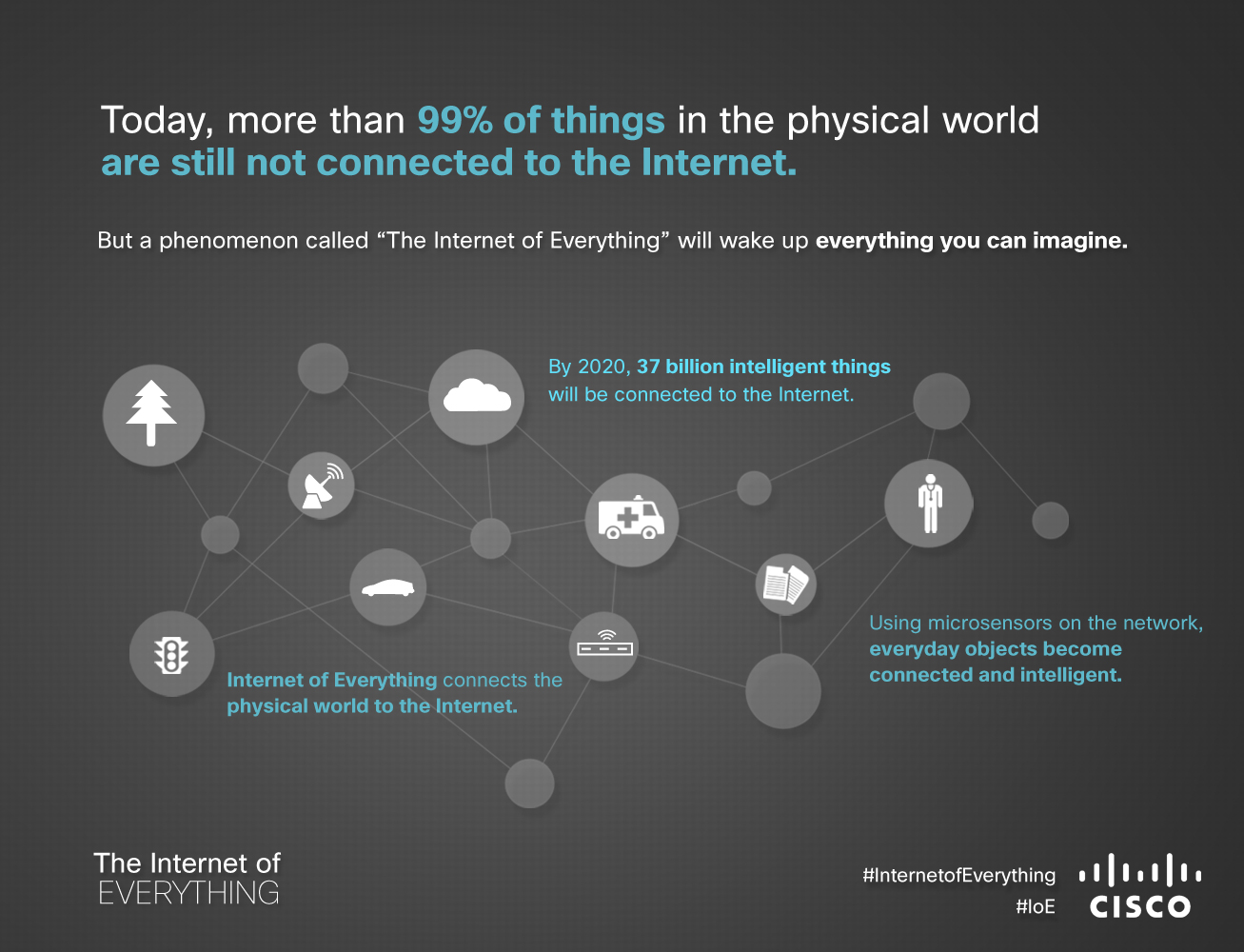
How the Internet of everything will change the world

November 8, 2012

IOE_Mini_Infographic

Internet-of-Everything

Internet of Everything (credit: Cisco)

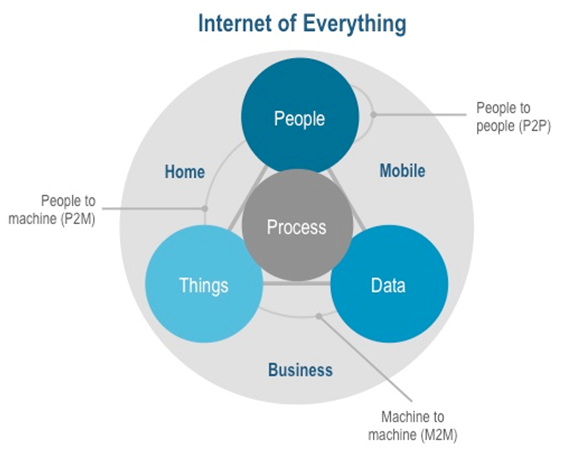
From the Internet of Things (IoT), where we are today, we are just beginning to enter a new realm: the Internet of Everything (IoE), where things will gain context awareness, increased processing power, and greater sensing abilities, says Cisco in their blog.

Add people and information into the mix and you get a network of networks where billions or even trillions of connections create unprecedented opportunities and give things that were silent a voice.

Cisco says their IoE as bringing together people, process, data, and things to make networked connections more relevant and valuable than ever before — turning information into actions that create new capabilities, richer experiences, and unprecedented economic opportunity for businesses, individuals, and countries.

Oct 27, 2012

Over 50% of oil use around the world is for transport and three-quarters of the energy used in the transport sector is consumed on the roads.
Current trends in energy supply and use are patently unsustainable – economically, environmentally and socially. Without decisive action, energy-related emissions of carbon dioxide (CO2) will more than double by 2050 and increased oil demand will heighten concerns over the security of supplies. We can and must change our current path, but this will take an energy prevolution and low-carbon energy technologies will have a crucial role to play. Energy efficiency, many types of renewable energy, carbon capture pand storage (CCS), nuclear power and new transport technologies will all require widespread deployment if we are to reach our greenhousegas (GHG) emission goals. Every major country and sector of the economy must be involved. The task is also urgent if we are to make sure that pinvestment decisions taken now do not saddle us with sub-optimal technologies in the long term. 

Oct 25, 2012

European Economic Woes Spur Separatists in Pockets of Prosperity

Can states of the "Old Continent" survive the economic crisis? Separatist movements across Europe have gained popularity during the last few months. The separatist New Flemish Alliance dominated Belgium's Dutch-speaking Flanders in the last elections; protests are held for the independence of Venice and South Tyrol in Italy; separatists remain strong in the Basque region of Spain; and respective referendums will decide the future of Catalonia and Scotland. Regions demanding autonomy are not the most affected by the crisis. On the contrary, in times of economic instability, "the separatist trend has been strongest in prosperous regions of Europe, where there is growing resentment at having to pay for the less well-off." (New York Times)

A new study by the left-of-center Economic Policy Institute, a research group in Washington, has found that the top 1 percent of households now hold a larger share of overall wealth than the bottom 90 percent does.

Income inequality has soared to the highest levels since the Great Depression, and the recession has done little to reverse the trend, with the top 1 percent of earners taking 93 percent of the income gains in the first full year of the recovery.

The yawning gap between the haves and the have-nots — and the political questions that gap has raised about the plight of the middle class — has given rise to anti-Wall Street sentiment and animated the presidential campaign. Now, a growing body of economic research suggests that it might mean lower levels of economic growth and slower job creation in the years ahead, as well.

“Growth becomes more fragile” in countries with high levels of inequality like the United States, said Jonathan D. Ostry of the International Monetary Fund, whose research suggests that the widening disparity since the 1980s might shorten the nation’s economic expansions by as much as a third.

Reducing inequality and bolstering growth, in the long run, might be “two sides of the same coin,” research published last year by the I.M.F. concluded.

Since the 1980s, rich households in the United States have earned a larger and larger share of overall income. The 1 percent earns about one-sixth of all income and the top 10 percent about half, according to statistics compiled by the respected economists Emmanuel Saez of the University of California, Berkeley and Thomas Piketty of the Paris School of Economics.

For years, economists have thought of such inequality in part as a side effect of policies that fostered the country’s economic dynamism — its tax preferences for investment income, for instance. And organizations like the World Bank and the I.M.F., which is based in Washington, have generally not tackled inequality in the world head on.

But economists’ thinking has changed sharply in recent years. The Organization for Economic Cooperation and Development this year warned about the “negative consequences” of the country’s high levels of pay inequality, and suggested an aggressive series of changes to tax and spending programs to tackle it.

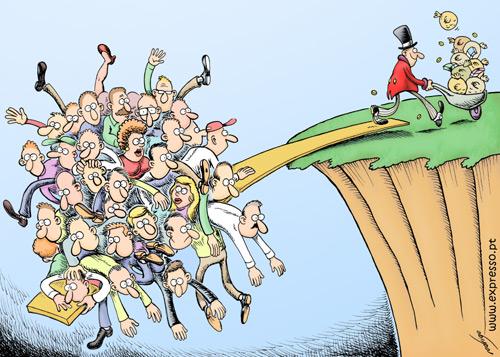
The I.M.F. has cautioned the United States, too. “Some dismiss inequality and focus instead on overall growth — arguing, in effect, that a rising tide lifts all boats,” a commentary by fund economists said. “When a handful of yachts become ocean liners while the rest remain lowly canoes, something is seriously amiss.”

Income Inequality May Take Toll on Growth

inequality2
Picture Credit: intelligentspeculator.net
 

In this article Annie Lowrey highlights the rising share of US income going to the highest earners. She argues that income inequality has a big impact on economic growth and, quotes an IMF economist, “when a handful of yachts become liners while the rest remain lowly canoes, something is seriously amiss.” While both US presidential candidates agree that restoring the “middle class” is crucial to the economy, they disagree strongly on the policy alternatives. Outcomes of these policies will be limited if there is no solid reform to the US economic and financial system.  


Sometimes we choose not to solve big technological problems.
Sometimes we fail to solve big problems because our institutions have failed.
Sometimes big problems that had seemed technological turn out not to be so, or could more plausibly be solved through other means. 
Finally, sometimes big problems elude any solution because we don't really understand the problem.
What to Do
It's not true that we can't solve big problems through technology; we can. We must. But all these elements must be present: political leaders and the public must care to solve a problem, our institutions must support its solution, it must really be a technological problem, and we must understand it. 
The Apollo program, which has become a metaphor for technology's capacity to solve big problems, met these criteria, but it is an irreproducible model for the future. This is not 1961: there is no galvanizing historical context akin to the Cold War, no likely politician who can heroize the difficult and dangerous, no body of engineers who yearn for the productive regimentation they had enjoyed in the military, and no popular faith in a science-fictional mythology such as exploring the solar system. Most of all, going to the moon was easy. It was only three days away. Arguably, it wasn't even solving much of a problem. We are left alone with our day, and the solutions of the future will be harder won. 
We don't lack for challenges. A billion people want electricity, millions are without clean water, the climate is changing, manufacturing is inefficient, traffic snarls cities, education is a luxury, and dementia or cancer will strike almost all of us if we live long enough. In this special package of stories, we examine these problems and introduce you to the indefatigable technologists who refuse to give up trying to solve them.

To contemporaries, the Apollo program occurred in the context of a long series of technological triumphs. The first half of the century produced the assembly line and the airplane, penicillin and a vaccine for tuberculosis; in the middle years of the century, polio was on its way to being eradicated; and by 1979 smallpox would be eliminated. More, the progress seemed to possess what Alvin Toffler dubbed an "accelerative thrust" in Future Shock, published in 1970. The adjectival swagger is pardonable: for decades, technology had been increasing the maximum speed of human travel. During most of history, we could go no faster than a horse or a boat with a sail; by the First World War, automobiles and trains could propel us at more than 100 miles an hour. Every decade thereafter, cars and planes sped humans faster. By 1961, a rocket-powered X-15 had been piloted to more than 4,000 miles per hour; in 1969, the crew of Apollo 10 flew at 25,000. Wasn't it the very time to explore the galaxy—"to blow this great blue, white, green planet or to be blown from it," as Saul Bellow wrote in Mr. Sammler's Planet (also 1970)?

Why we cant solve big problems

http://www.technologyreview.com/featuredstory/429690/why-we-cant-solve-big-problems/

The great energy transition from fossil fuels to renewable sources of energy is under way. As fossil fuel prices rise, as oil insecurity deepens, and as concerns about pollution and climate instability cast a shadow over the future of coal, a new world energy economy is emerging. The old energy economy, fueled by oil, coal, and natural gas, is being replaced with an economy powered by wind, solar, and geothermal energy. The Earth’s renewable energy resources are vast and available to be tapped through visionary initiatives. Our civilization needs to embrace renewable energy on a scale and at a pace we’ve never seen before. 

We inherited our current fossil fuel based world energy economy from another era. The 19th century was the century of coal, and oil took the lead during the 20th century. Today, global emissions of carbon dioxide (CO2)—the principal climate-altering greenhouse gas—come largely from burning coal, oil, and natural gas. Coal, mainly used for electricity generation, accounts for 44 percent of global fossil-fuel CO2 emissions. Oil, used primarily for transportation, accounts for 36 percent. Natural gas, used for electricity and heating, accounts for the remaining 20 percent. It is time to design a carbon- and pollution-free energy economy for the 21st century.

Oct 24, 2012

Among the trends:

  • Protesters around the world show a growing unwillingness to tolerate unethical decisionmaking by power elites.
  • An increasingly educated and Internet-connected generation is rising up against the abuse of power.
  • Food prices are rising, water tables are falling, corruption and organized crime are increasing, environmental viability for our life support is diminishing, debt and economic insecurity are increasing, climate change continues, and the gap between the rich and poor continues to widen dangerously. However, the most recent data from the World Bank shows that the share of world population living in extreme poverty has fallen from 52% in 1981 to about 20% in 2010.
  • The world is in a race between implementing ever-increasing ways to improve the human condition and the seemingly ever-increasing complexity and scale of global problems.

“The world is getting richer, healthier, better educated, more peaceful, and better connected, and people are living longer; yet half the world is potentially unstable,” according to Jerome C. Glenn, CEO of The Millennium Project and co-author of the “2012 State of the Future,” an overview of our global situation, problems, solutions, and prospects for the future.

The 16th Annual Edition includes 145 pages and a 10,000 page electronic supplement with more than 1,500 additional pages of detailed current material, and searchable research from the past 16 years. It is available on CD, USB flash drive, or download.

The report is a distillation of research, including tables, graphs, and charts with special chapters on 15 Global Challenges, the State of the Future Index, changing stereotypes about women around the world over the past 50 years and projected next 50 years, future factors affecting cooperatives and businesses, and futures of ontologists.

Oct 20, 2012

In fact, this issue is just the latest incarnation of a rather old debate. Walter Lippmann famously argued that public opinion was too fickle to be a reliable guide to policy, and that better-informed elites would have to "manufacture consent" in order to lead effectively. Realists like George Kennan used to worry that democracies were no good at statecraftbecause public passions would warp the conduct of foreign policy, although other scholars have argued that democracies often out-perform authoritarian states because they are better at correcting their mistakes. Social scientists have long debated whether media coverage has any systematic effect on wartime behavior, military intervention, or other foreign policy elements.

Oct 11, 2012

Facts are being manufactured all of the time, and, as Arbesman shows, many of them turn out to be wrong. Checking each by each is how the scientific process is supposed work, i.e., experimental results need to be replicated by other researchers. How many of the findings in 845,175 articles published in 2009 and recorded in PubMed, the free online medical database, were actually replicated? Not all that many. In 2011, a disheartening study in Nature reported that a team of researchers over ten years was able to reproduce the results of only six out of 53 landmark papers in preclinical cancer research.

The field of scientometrics – the science of measuring and analyzing science – took off in 1947 when mathematician Derek J. de Solla Price was asked to store a complete set of the Philosophical Transactions of the Royal Society temporarily in his house. He stacked them in order and he noticed that the height of the stacks fit an exponential curve. Price started to analyze all sorts of other kinds of scientific data and concluded in 1960 that scientific knowledge had been growing steadily at a rate of 4.7 percent annually since the 17th century. The upshot was that scientific data was doubling every 15 years.

Terrorism is an enduring reality. While geopolitical changes may cause a shift in the actors who employ terrorism as a tactic, terrorism will continue to be used no matter what the next geopolitical cycle brings. It is, and will continue to be, a tactic used by militant actors who want to confront a militarily superior enemy. Focusing on the tradecraft used in attacks and charting its changes and trends not only permits observers to understand what is happening and why but also provides an opportunity to forecast what is coming next.

Oct 5, 2012

A new digital revolution is coming, this time in fabrication. It draws on the same insights that led to the earlier digitizations of communication and computation, but now what is being programmed is the physical world rather than the virtual one. Digital fabrication will allow individuals to design and produce tangible objects on demand, wherever and whenever they need them. Widespread access to these technologies will challenge traditional models of business, aid, and education.

Oct 3, 2012

Urban areas around the world are expanding at twice the rate of their populations, reversing historic trends toward increased density within city limits. The result will be more loss of habitat and biodiversity, warns a team of researchers in a new paper published in the Proceedings of the National Academy of Sciences.

More than 1 million square kilometers of land—largely in biodiversity “hotspots”—have a high probability of being converted to urban use by 2030, with nearly half of the expansion occurring in Asia (primarily China and India), according to the authors. However, the fastest land-to-urban conversion will occur in Africa, which will see urban land cover grow 590% above the 2000 level.

Oct 2, 2012

Lester R. Brown

Presentations for Full Planet, Empty Plates: The New Geopolitics of Food Scarcity

APPETIZER
Download brief overview presentation in PowerPoint (24 slides, 3.7 MB)
Download brief overview presentation as PDF (3.2 MB)

FULL SUMMARY
Download full summary presentation in PowerPoint (79 slides, 12.1 MB)
Download full summary presentation as PDF (12.1 MB)

Sep 7, 2012

http://www.theatlantic.com/special-report/ideas-2012/

Aug 17, 2012

Scientists at the Harvard-Smithsonian Center for Astrophysics (CfA) and their colleagues at the Heidelberg Institute for Theoretical Studies(HITS) have invented a new computational approach that can accurately follow the birth and evolution of thousands of galaxies over billions of years.

For the first time, it’s now possible to build a universe from scratch that brims with galaxies like those we observe around us.

Jun 15, 2012

William Jennings Bryan  told a gathering of businessmen in 1915 that “my Department is your department; the ambassadors, the ministers, the consuls are all yours; it is their business to look after your interests and to guard your rights,” they were enunciating the soul of American foreign policy, as was the much-lauded Wise Man George Kennan when he wrote in a post-World War II State Department policy planning document: “We have about 50 percent of the world’s wealth, but only 6.3 percent of its population … In this situation, we cannot fail to be the object of envy and resentment. Our real task in the coming period is to devise a pattern of relationships which will permit us to maintain this position of disparity … To do so, we will have to dispense with all sentimentality and day-dreaming; and our attention will have to be concentrated everywhere on our immediate national objectives … We should cease to talk about vague and … unreal objectives such as human rights, the raising of the living standards, and democratization. The day is not far off when we are going to have to deal in straight power concepts. The less we are then hampered by idealistic slogans, the better.” 

Pretty bad. Here is a sample of factlets from surveys and studies conducted in the past twenty years. Seventy percent of Americans believe in the existence of angels. Fifty percent believe that the earth has been visited by UFOs; in another poll, 70 percent believed that the U.S. government is covering up the presence of space aliens on earth. Forty percent did not know whom the U.S. fought in World War II. Forty percent could not locate Japan on a world map. Fifteen percent could not locate the United States on a world map. Sixty percent of Americans have not read a book since leaving school. Only 6 percent now read even one book a year. According to a very familiar statistic that nonetheless cannot be repeated too often, the average American’s day includes six minutes playing sports, five minutes reading books, one minute making music, 30 seconds attending a play or concert, 25 seconds making or viewing art, and four hours watching television.

Among high-school seniors surveyed in the late 1990s, 50 percent had not heard of the Cold War. Sixty percent could not say how the United States came into existence. Fifty percent did not know in which century the Civil War occurred. Sixty percent could name each of the Three Stooges but not the three branches of the U.S. government. Sixty percent could not comprehend an editorial in a national or local newspaper.

How Bad Is It? – (New Inquiry – May 26, 2012)
'During the last third of the twentieth century,” according to Robert Putnam in Bowling Alone, 'all forms of social capital fell off precipitously.” Tens of thousands of community groups – church social and charitable groups, union halls, civic clubs, bridge clubs, and yes, bowling leagues - disappeared; by Putnam’s estimate, one-third of our social infrastructure vanished in these years. Frequency of having friends to dinner dropped by 45%; card parties declined 50%; Americans’ declared readiness to make new friends declined by 30%. Belief that most other people could be trusted dropped from 77% to 37%. Over a five-year period in the 1990s, reported incidents of aggressive driving rose by 50% - admittedly an odd, but probably not an insignificant, indicator of declining social capital. In Spenglerian fashion, Morris Berman (author of Why America Failed(2011)), seeks the source of our civilization’s decline in its innermost principle, its animating Geist. What he finds at the bottom of our culture’s soul is -- hustling; or, to use its respectable academic sobriquet, possessive individualism. (Editor’s note: Going well beyond statistics, this essay is worth the reader’s time.)

We Will Rue Stuxnet’s Cavalier Deployment – (Financial Times – June 6, 2012)
An arms race in cyberspace is a distinct reality. The existence of the Flame malware shocked computer security specialists. The fact that Flame has been going about its business for several years without anybody having noticed it means that millions of dollars must have been invested in creating the virus to ensure it remained undetected. In a second development, three days after the news about Flame, the White House revealed that the US had been behind the development and deployment of Flame’s most notorious predecessor, Stuxnet, which targeted Natanz, Iran’s uranium enrichment facility. The American admission will act as a starting gun: countries around the world can now argue that it is legitimate to use malware pre-emptively against their enemies. The pre-emptive act against Iran sets an ugly precedent. There is no legal framework restraining intelligence agencies or the military from investing in and then testing these weapons. The implications are grave. Recently, for example, Bavarian police unwittingly allowed some specialist surveillance software to slip on to the web. The program was so intrusive that Germany’s highest court had deemed it unconstitutional. It was almost immediately spotted and copied by Europe’s oldest hacking group, the Chaos Computer Club, a relatively benign organization. But there is no knowing who else has picked up the software or even started using it. See also: Germany has confirmed that its military maintains an operational cyberwarfare unit with offensive capabilities. Prof. Dr. Wolff Heintschel von Heinegg, a professor of law at European University Viadrina Frankfurt in Germany, said that “the armed forces of many nations are probably building up an offensive cyber capability. The only difference is that Germany and (also recently) the Obama administration in the US are publicly talking about it.” He added that “cyber-espionage activities are not prohibited by codes of international law but only national criminal laws.” 

Will Our Kids Be a Different Species? – (TED – June, 2012)
Throughout human evolution, multiple versions of humans co-existed. Could we be mid-upgrade now? In this TED talk, Juan Enriquez sweeps across time and space to bring us to the present moment—and shows how technology is revealing evidence that suggests rapid evolution may be under way. Juan Enriquez thinks and writes about profound changes that genomics will bring in business, technology, and society. His TED Book,Homo Evolutis, explores those changes. Enriquez was the founding director of the Harvard Business School Life Sciences Project, has published widely on topics from the technical (global nucleotide data flow) to the sociological (gene research and national competitiveness), and was a member of Celera Genomics founder Craig Venter's marine-based team to collect genetic data from the world's oceans.