Sep 30, 2005
Ray Kurzweil deciphers a brave new world | Newsmakers | CNET News.com: "Thanks to Moore's Law and other exponential growth rates, by 2030 a $1 computer will be as powerful as the human brain. Information technology's exponential curve will fuel advances in biology, robotics, nanotechnology and artificial intelligence--with world-shattering results including radical life extension and practically omniscient and omnipotent abilities for humans who elect self-augmentation. "

Wired News: Mighty Mice Regrow Organs: "Genetically altered mice discovered accidentally at the Wistar Institute in Pennsylvania have the seemingly miraculous ability to regenerate like a salamander, and even regrow vital organs.
Researchers systematically amputated digits and damaged various organs of the mice, including the heart, liver and brain, most of which grew back.
The results stunned scientists because if such regeneration is possible in this mammal, it might also be possible in humans.
The researchers also made a remarkable second discovery: When cells from the regenerative mice were injected into normal mice, the normal mice adopted the ability to regenerate. And when the special mice bred with normal mice, their offspring inherited souped-up regeneration capabilities. "
Researchers systematically amputated digits and damaged various organs of the mice, including the heart, liver and brain, most of which grew back.
The results stunned scientists because if such regeneration is possible in this mammal, it might also be possible in humans.
The researchers also made a remarkable second discovery: When cells from the regenerative mice were injected into normal mice, the normal mice adopted the ability to regenerate. And when the special mice bred with normal mice, their offspring inherited souped-up regeneration capabilities. "
Sep 29, 2005
PINR - Confrontation Looms as I.A.E.A. Passes Resolution on Iran: "That being said, India did vote in favor of the I.A.E.A. resolution due to its hope of acquiring more nuclear technology from the United States. In July 2005, India and the U.S. signed a nuclear deal that granted New Delhi access to civilian nuclear energy cooperation;"
PINR - Confrontation Looms as I.A.E.A. Passes Resolution on Iran: "Furthermore, China and Russia have been improving their bilateral relations and have been cooperating in order to limit the spread of U.S. influence in Central Asia."
PINR - Confrontation Looms as I.A.E.A. Passes Resolution on Iran: "About 15 percent of China's imported oil and natural gas comes from Iran, and U.S. attempts to destabilize Iran would pose a threat to China's energy and economic interests. "
PINR - Confrontation Looms as I.A.E.A. Passes Resolution on Iran: "Nevertheless, the United States does not consider military action against Iran a viable option under the present circumstances. For instance, the ongoing insurgency in Iraq has resulted in the overextension of the U.S. military; many of Iran's nuclear facilities are believed to be hidden, making it difficult to eliminate its nuclear research program through air strikes; and, the skyrocketing price of oil is weakening the economies of oil-dependent countries, and any military move on Iran would add more instability to energy supplies, thus lifting oil prices even higher."
Sep 28, 2005
Foreign Affairs - A Trade War with China? - Neil C. Hughes: "China is not stealing U.S. jobs or engaging in unfair trade practices to undercut U.S. economic might and export its way to global power. In fact, almost 60 percent of Chinese exports to the United States are produced by firms owned by foreign companies, many of them American. These firms have moved operations overseas in response to competitive pressures to lower production costs and thereby offer better prices to consumers and higher returns to shareholders. U.S. importers with dominant positions in China, such as Wal-Mart and Hallmark, have the power to compel Chinese suppliers to keep their costs as low as possible. Wal-Mart alone purchased $18 billion worth of Chinese goods in 2004, making it China's eighth-largest trading partner -- ahead of Australia, Canada, and Russia.
So who is really 'to blame' for China's 'exporting deflation' and for the surge of Chinese exports? American importers, the American consumers who buy their Chinese goods at very low prices, and their American shareholders who demand results. A sustained trade war with China would hurt these groups more than anyone else."
So who is really 'to blame' for China's 'exporting deflation' and for the surge of Chinese exports? American importers, the American consumers who buy their Chinese goods at very low prices, and their American shareholders who demand results. A sustained trade war with China would hurt these groups more than anyone else."
Foreign Affairs - A Trade War with China? - Neil C. Hughes: "Summary: With China's economic clout growing rapidly, Americans are accusing Beijing of every offense from currency manipulation to crooked trade policies. None of these charges has much merit, but they have increased the probability of a U.S.-Chinese trade war that would do considerable damage to both sides."
Foreign Affairs - The Human-Animal Link - William B. Karesh and Robert A. Cook: "Not only is local and national health care often a problem; internationally, no agency is responsible for, or capable of, monitoring and preventing the myriad diseases that can now cross the borders between countries and species. More specifically, no organization has the mandate to pursue policies based on a simple but critically important concept: that the health of people, animals, and the environment in which we all live are inextricably linked."
Foreign Affairs - The Human-Animal Link - William B. Karesh and Robert A. Cook: "Meanwhile, humanity has become vulnerable to cross-species illnesses, thanks to modern advances such as the rapid transportation of both goods and people, increasing population density around the globe, and a growing dependence on intensified livestock production for food. The global transport of animals and animal products, which includes hundreds of species of wildlife, also provides safe passage for the harmful bacteria, viruses, and fungi they carry, not to mention the prion proteins that cause insidious illnesses such as mad cow disease and chronic wasting disease in deer and elk."
Foreign Affairs - The Future of Energy Policy - Timothy E. Wirth, C. Boyden Gray, and John D. Podesta: "Energy is fundamental to U.S. domestic prosperity and national security. In fact, the complex ties between energy and U.S. national interests have drawn tighter over time. The advent of globalization, the growing gap between rich and poor, the war on terrorism, and the need to safeguard the earth's environment are all intertwined with energy concerns."
Foreign Affairs - The Future of Energy Policy - Timothy E. Wirth, C. Boyden Gray, and John D. Podesta: "Summary: The debate over energy policy in the United States has consistently failed to grapple with the large issues at stake. It is time for an ambitious new approach to U.S. strategic energy policy, one that deals with the problems of oil dependence, climate change, and the developing world's lack of access to energy."
Foreign Affairs - Development and Democracy - Bruce Bueno de Mesquita and George W. Downs: "What explains the often lengthy lag between the onset of economic growth and the emergence of liberal democracy? The answer lies in the growing sophistication of authoritarian governments. Although development theorists are right in assuming that increases in per capita income lead to increases in popular demand for political power, they have consistently underestimated the ability of oppressive governments to thwart those demands. "
Foreign Affairs - Development and Democracy - Bruce Bueno de Mesquita and George W. Downs: "This prediction was not specific to China. Until quite recently, conventional wisdom has held that economic development, wherever it occurs, will lead inevitably -- and fairly quickly -- to democracy. The argument, in its simplest form, runs like this: economic growth produces an educated and entrepreneurial middle class that, sooner or later, begins to demand control over its own fate. Eventually, even repressive governments are forced to give in."
Foreign Affairs - China's Global Hunt for Energy - David Zweig and Bi Jianhai: "China's resources hunt has been a boon to some states, especially developing countries, as it has allowed them to exploit as yet untapped resources or gain leverage to negotiate better deals with older customers. But for other states, particularly the United States and Japan, China's insatiability is causing concern. Some governments worry as Beijing enters their spheres of influence or strikes deals with states they have tried to marginalize."
Foreign Affairs - China's Global Hunt for Energy - David Zweig and Bi Jianhai: "Partly on these people's advice, Beijing has been encouraging representatives of state-controlled companies to secure exploration and supply agreements with states that produce oil, gas, and other resources. Meanwhile, it has been courting the governments of these states aggressively, building goodwill by strengthening bilateral trade relations, awarding aid, forgiving national debt, and helping build roads, bridges, stadiums, and harbors. In return, China has won access to key resources, from gold in Bolivia and coal in the Philippines to oil in Ecuador and natural gas in Australia."
Foreign Affairs - China's Global Hunt for Energy - David Zweig and Bi Jianhai: "Twenty years ago, China was East Asia's largest oil exporter. Now it is the world's second-largest importer; last year, it alone accounted for 31 percent of global growth in oil demand. Now that China is the workshop of the world, its hunger for electricity and industrial resources has soared. China's combined share of the world's consumption of aluminum, copper, nickel, and iron ore more than doubled within only ten years, from 7 percent in 1990 to 15 percent in 2000"
Foreign Affairs - China's Global Hunt for Energy - David Zweig and Bi Jianhai: "Chinese foreign policy is now driven by China's unprecendented need for resources. In exchange for access to oil and other raw materials to fuel its booming economy, Beijing has boosted its bilateral relations with resource-rich states, sometimes striking deals with rogue governments or treading on U.S. turf. Beijing's hunger may worry some in Washington, but it also creates new grounds for cooperation."
Sep 27, 2005
AACC - building a futures exercise: "To understand the factors that might influence a future state.
To use math or statistics to estimate a future state or condition.
To use writing and thinking strategies to outline a future scenario for any discipline or field� society itself.. the list goes on."
To use math or statistics to estimate a future state or condition.
To use writing and thinking strategies to outline a future scenario for any discipline or field� society itself.. the list goes on."
AACC - futures resources - Thinking about the future: "A definitive description of the emerging discipline of futures studies. Volume I is about forecasting; Volume II is about values.
The Knowledge Base of Futures Studies: Professional Edition edited by Richard A. Slaughter. Foresight International, 2005. "
The Knowledge Base of Futures Studies: Professional Edition edited by Richard A. Slaughter. Foresight International, 2005. "
What's Next - Top Trends in Science, technology & design: "Expect computers to become more intelligent than humans by about 2025. At this point humankind will be faced with something of a dilemma. "
What's Next - Top Trends in Science, technology & design: Nanotechnoloy (i.e.the manipulation of structures at an atomic level — or the science of very small things) is the hyped technology of the new millennium. It’s unlikely to disappoint either because it’s a disruptive technology.
Sep 23, 2005
: "Terror attacks indicates - at least to our understanding - that the entire world community is caught in cycles of humiliation. Men such as Osama bin Laden would never have any followers, if there were not a pool of sullen feelings of humiliation somewhere, feelings that are so intense that young intelligent men, who could found families and have satisfying careers, are willing to follow such leaders and lose their lives in destroying other lives. "
: "in the first instance, it augments feelings of debasement, because inequalities and deprivation that were accepted before turn into unacceptable acts of humiliation perpetrated by the powerful on the less powerful. The promise of human rights, the promise of equal dignity for all, if unfulfilled, creates an expectation gap that can translate into wounds of humiliation if it is being perceived to be inflicted by perpetrators, either intentionally or through negligence. And, as mentioned already, acts of debasement create feelings of humiliation that in turn have a potential to lead to retaliating acts of debasement."
: "Nowadays, we no longer make people accept explanations for inequality and deprivation that allude to God's will, or to nature's order, or to punishment for past failings. We live in a world that is permeated by the promise of human rights that indicates that every human being has a right to live in enabling circumstances, that egality is the ruling idea and not hierarchy, that every person has an inner core of dignity that ought not be lowered. International experience indicates that this message indeed is heard. "
: "Vamik Volkan (2004) has developed a theory of collective violence, which he puts forth in his recent book Blind Trust: Large groups and their leaders in times of crisis and terror. He explains that when a chosen trauma that is experienced as humiliation is not mourned, it may lead to the feeling of entitlement to revenge and, under the pressure of fear/anxiety, to collective regression "
: "Thomas Friedman in the New York Times, states, 'If I've learned one thing covering world affairs, it's this: The single most underappreciated force in international relations is humiliation' (New York Times, November 9, 2003).
Aaron Lazare (2004) writes: 'I believe that humiliation is one of the most important emotions we must understand and manage, both in ourselves and in others, and on an individual and national level' (Aaron Lazare, 2004, On Apology. New York, NY: Oxford University Press, p. 262-263)."
Aaron Lazare (2004) writes: 'I believe that humiliation is one of the most important emotions we must understand and manage, both in ourselves and in others, and on an individual and national level' (Aaron Lazare, 2004, On Apology. New York, NY: Oxford University Press, p. 262-263)."
Sep 20, 2005
People's Daily Online -- OECD: China to become largest exporter in five years: "The Organization of Economic Cooperation and Development (OECD) made a comprehensive assessment of Chinese economy for the first time in its latest report. The report says judging by China's current situation and development it is likely to outpace the US and Germany to become the largest exporter and the fourth largest economic entity in the world. By then goods and service from China would account for 10 percent of international trade volume while the current figure is 6 percent. "
Sep 19, 2005
People's Daily Online -- China to cap population at 1.37 billion by 2010: "China's population and family planning minister said China would work to limit its mainland population to below 1.37 billion by 2010. "
Sep 17, 2005
The Power and Interest News Report (PINR): "France and Germany have gradually absorbed some 'Anglo-Saxon liberalism' prerogatives due to American power and influence, and thanks to the post-WWII world configuration, at a time when they needed strong relationships with the U.S. and Britain. However, they have also retained some of their respective traditions of strong state intervention in the economy, and often perceive economic globalization as an American strategy to impose U.S. economic power.
Both countries still maintain their most enduring foreign policy goals -- i.e. controlling the heart of Europe and projecting their power globally after having securitized their original geopolitical environment. A balanced multipolar world is what they perceive as in their global interest. In this sense, they oppose Anglo-American hegemony over the West, but their ruling classes are split between those who believe it is necessary to copy the current British social model in order to compete more effectively, and those who maintain that their country can effectively compete only if it can revive its own specific national model."
Both countries still maintain their most enduring foreign policy goals -- i.e. controlling the heart of Europe and projecting their power globally after having securitized their original geopolitical environment. A balanced multipolar world is what they perceive as in their global interest. In this sense, they oppose Anglo-American hegemony over the West, but their ruling classes are split between those who believe it is necessary to copy the current British social model in order to compete more effectively, and those who maintain that their country can effectively compete only if it can revive its own specific national model."
Sep 16, 2005
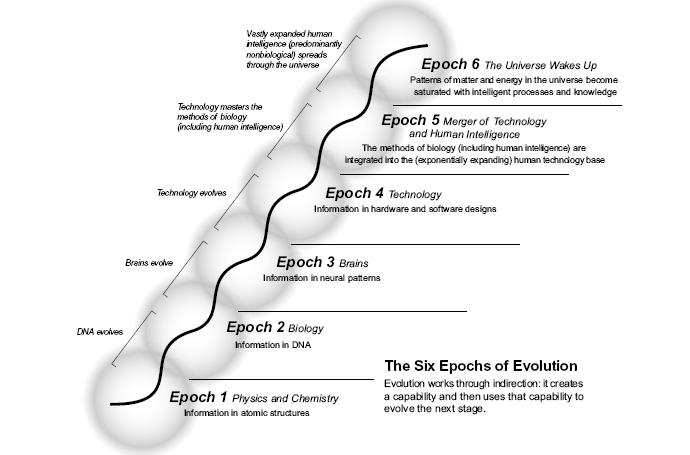
Recent theories of physics concerning multiple universes speculate that new universes are created on a regular basis, each with its own unique rules, but that most of these either die out quickly or else continue without the evolution of any interesting patterns (such as Earth-based biology has created) because their rules do not support the evolution of increasingly complex forms.
Most technology forecasts and forecasters ignore altogether this historical exponential view of technological progress. Indeed, almost everyone I meet has a linear view of the future. That’s why people tend to overestimate what can be achieved in the short term (because we tend to leave out necessary details) but underestimate what can be achieved in the long term (because exponential growth is ignored).
The Singularity will represent the culmination of the merger of our biological thinking and existence with our technology, resulting in a world that is still human but that transcends our biological roots. There will be no distinction, post-Singularity, between human and machine or between physical and virtual reality. If you wonder what will remain unequivocally human in such a world, it’s simply this quality: ours is the species that inherently seeks to extend its physical and mental reach beyond current limitations.
Although impressive in many respects, the brain suffers from severe limitations. We use its massive parallelism (one hundred trillion interneuronal connections operating simultaneously) to quickly recognize subtle patterns. But our thinking is extremely slow: the basic neural transactions are several million times slower than contemporary electronic circuits.
Consider Gary Kasparov, who scorned the pathetic state of computer chess in 1992. Yet the relentless doubling of computer power every year enabled a computer to defeat him only five years later.2 The list of ways computers can now exceed human capabilities is rapidly growing.Moreover, the once narrow applications of computer intelligence are gradually broadening in one type of activity after another. For example, computers are diagnosing electrocardiograms
and medical images, flying and landing airplanes, controlling the tactical decisions of automated weapons, making credit and financial decisions, and
being given responsibility for many other tasks that used to require human intelligence. The performance of these systems is increasingly based on integrating multiple types of artificial intelligence (AI). But as long as there is an AI shortcoming in any such area of endeavor, skeptics will point to that area as an inherent bastion of permanent human superiority over the capabilities of our own creations.
and medical images, flying and landing airplanes, controlling the tactical decisions of automated weapons, making credit and financial decisions, and
being given responsibility for many other tasks that used to require human intelligence. The performance of these systems is increasingly based on integrating multiple types of artificial intelligence (AI). But as long as there is an AI shortcoming in any such area of endeavor, skeptics will point to that area as an inherent bastion of permanent human superiority over the capabilities of our own creations.
The same observation holds for the “inventions” of biological evolution: consider that the genetic difference between chimpanzees and humans, for example, is only a few hundred thousand bytes of information. Although chimps are capable of some intellectual feats, that tiny difference in our genes was sufficient for our species to create the magic of technology.
Our progress in reverse engineering the human brain, a key issue that I will describe in detail in this book, demonstrates that we do indeed have the ability to understand, to model,
and to extend our own intelligence. This is one aspect of the uniqueness of our species: our intelligence is just sufficiently above the critical threshold necessary for us to scale our own ability to unrestricted heights of creative power— and we have the opposable appendage (our thumbs) necessary to manipulate the universe to our will.
and to extend our own intelligence. This is one aspect of the uniqueness of our species: our intelligence is just sufficiently above the critical threshold necessary for us to scale our own ability to unrestricted heights of creative power— and we have the opposable appendage (our thumbs) necessary to manipulate the universe to our will.
AI researcher Douglas Hofstadter muses that “it could be simply an accident of fate that our brains are too weak to understand themselves. Think of the lowly giraffe, for instance, whose brain
is obviously far below the level required for self-understanding—yet it is remarkably similar to our brain.”6 However, we have already succeeded in
modeling portions of our brain—neurons and substantial neural regions— and the complexity of such models is growing rapidly.
is obviously far below the level required for self-understanding—yet it is remarkably similar to our brain.”6 However, we have already succeeded in
modeling portions of our brain—neurons and substantial neural regions— and the complexity of such models is growing rapidly.
The story is predicated on the idea that we have the ability to understand our own intelligence—to access our own source code, if you will—and then revise and expand it.
Over the last twenty years, I have come to appreciate an important metaidea: that the power of ideas to transform the world is itself accelerating. Although people readily agree with this observation when it is simply stated, relatively few observers truly appreciate its profound implications.Within the next several decades, we will have the opportunity to apply ideas to conquer age-old problems—and introduce a few new problems along the way.
The Power of IdeasI began to develop models of how distinct technologies—electronics, communications, computer processors, memory, magnetic storage, and others—developed and how these changes rippled through markets and ultimately our social institutions. I realized that most inventions fail not because the R&D department can’t get them to work but because the timing is wrong. Inventing is a lot like surfing: you have to anticipate and catch the wave at just the right moment.
Singularity is Near - About the Book: "the dawning of a new civilization that will enable us to transcend our biological limitations and amplify our creativity."
Singularity is Near - About the Book: "That merging is the essence of the Singularity, an era in which our intelligence will become increasingly nonbiological"
Singularity is Near - About the Book: "In his classic The Age of Spiritual Machines, he presented the daring argument that with the ever-accelerating rate of technological change, computers would rival the full range of human intelligence at its best. Now, in The Singularity Is Near, he examines the next step in this inexorable evolutionary process: the union of human and machine, in which the knowledge and skills embedded in our brains will be combined with the vastly greater capacity, speed, and knowledge-sharing ability of our own creations."
Singularity is Near - About the Book: "That merging is the essence of the Singularity, an era in which our intelligence will become increasingly nonbiological and trillions of times more powerful than it is today�the dawning of a new civilization that will enable us to transcend our biological limitations and amplify our creativity. In this new world, there will be no clear distinction between human and machine, real reality and virtual reality"
Singularity is Near - About the Book: "Now, in The Singularity Is Near, he examines the next step in this inexorable evolutionary process: the union of human and machine, in which the knowledge and skills embedded in our brains will be combined with the vastly greater capacity, speed, and knowledge-sharing ability of our own creations."
Subscribe to:
Posts (Atom)


 Posts
Posts

