Oct 20, 2011

The Race for Genetic Enhancements Will Be What the Space Race Was in the 20th Century—Genetic therapies and biomedical enhancements will be a multibillion-dollar industry. New techniques will enable doctors to change your DNA to revitalize old or diseased organs, enhance your appearance, increase your athletic ability, or boost your intelligence.

Oct 19, 2011

Now, there is a new trend that is rapidly proliferating across the world: unhappiness with leadership. It's as though the uprisings of northern Africa, focused on very specific, authoritarian leaders, has turned into broad-based global demonstrations against leadership, in places where it was never previously thought possible. 

I was with a retired army colonel recently who mentioned that throughout his career he had many times told friends from other countries where he had served that the American people would never revolt against their government. He doesn't know about that now. He was responding to the Occupy Wall Street demonstrations, now more than a month long that have spread to 30 U.S. cities and drew 20,000 participants in New York a week ago. 

In preparing for a talk that I will give later this week in Santiago, Chile, I discovered that United for Global Change -- the central site for the movement organizing worldwide protests -- said 951 cities in 82 countries were to take part in the demonstrations after online organizers called for a worldwide rally. This is particularly of interest to the Chileans I will be visiting since their students have been on strike for many months now calling for free education (they'll lose one year of school because of their commitment). One of my talks at a university was cancelled because of massive, city-wide demonstrations that are planned to take place while I will be there. 

What's interesting about this growing trend of broad-based discontentment with the status quo is that it is moving into the middle and upper classes. In the U.S., for example, when mainline commentators like Suze Orman start to endorse the concerns of demonstrators and magazines like The New Yorker publish covers like this, then you know that a very sensitive nerve has been touched by those mostly young people who are camping in the rain to try to influence significant change. 


An even more interesting data point is when Warren Buffett, one of the wealthiest men in America chimed in to suggest that the constitution needs to be changed to make it impossible to allow all politicians to run for reelection if the national debt exceeds 3% of the present ceiling. Now, that would certainly get their attention! 

Oct 18, 2011

Friedman and Mandelbaum describe the US Congress as "increasingly beholden to the wealthiest and most politically extreme interests in America" and the political system in general as "under the sway of powerful special interests that work for policies that are at best irrelevant to and at worst counterproductive for the urgent present and future needs of the United States". 

The world is caught in a dangerous feedback loop - higher oil prices and climate disruptions lead to higher food prices, higher food prices lead to more instability, more instability leads to higher oil prices. That loop is shaking the foundations of politics everywhere. 

Oct 17, 2011

 International

Much of this Web site examines the performance of the U.S. economy over time—using historical outcomes as a benchmark. This section instead compares the United States across space—benchmarking its performance to its global peers, the 19 other richest industrialized countries of the Organization for Economic Cooperation and Development. The comparison thus provides an alternative yardstick to gauge the strengths and weaknesses of the U.S. economy.


Oct 13, 2011

No wonder Jim O’Neill, who coined the neologism BRIC and is now chairman of Goldman Sachs Asset Management, has been stressing that “the world is no longer dependent on the leadership of the U.S. and Europe.”  After all, since 2007, China’s economy has grown by 45%, the American economy by less than 1% -- figures startling enough to make anyone take back their predictions. American anxiety and puzzlement reached new heights when the latest International Monetary Fund projections indicated that, at least by certain measurements, the Chinese economy would overtake the U.S. by 2016.  (Until recently, Goldman Sachs was pointing towards 2050 for that first-place exchange.)

Within the next 30 years, the top five will, according to Goldman Sachs, likely be China, the U.S., India, Brazil, and Mexico. Western Europe?  Bye-bye!

More than a decade ago, the BRIC countries were predicted to make the world economy’s top ten, but not until 2040. Ten years have passed and China already holds spot number two, Brazil is number seven, India ten and Russia is closing in. Although the US economy is still the number one, its moment as the sole superpower was only “15 minutes of fame”. The US is a giant power, economically and politically paralyzed, and seems incapable of finding an exit strategy.

Oct 12, 2011


Earth Policy Release
Eco-Economy Indicator
October 12, 2011

The number of people in the world is expected to reach 7 billion by the end of October 2011. Our rate of increase continues to slow from the high point of over 2 percent in 1968. Still, this year's 1.1 percent increase means some 78 million people will be added to the global population in 2011. 

The human population did not reach 1 billion until the early nineteenth century, and it took more than 100 years to reach 2 billion. After that, the intervals between billions grew even shorter: we added the third billion in 33 years, the fourth in 14 years, the fifth in 13 years, and the sixth and seventh in 12 years each. Anyone alive today who was born by 1940 has seen our numbers triple. The most widely cited United Nations projection shows world population hitting 8 billion in 2025 and 10 billion before the end of this century.

Graph on World Population, 1950-2010, with Projection to 2100

With populations stabilizing in much of the industrial world, almost all population growth in the near future is expected to occur in developing countries. Of the 2.3 billion people to be added by 2050, more than a billion will live in sub-Saharan Africa. The Indian subcontinent will add some 630 million people.

Table on World Population Milestones

Differences in population growth rates are largely due to varying fertility levels. Global fertility has dropped from close to 5 births per woman in the 1950s to 2.5 births per woman today. Over 40 percent of the world's people live in countries where fertility is below replacement level. But fertility varies widely across countries. In Niger, women have more than 7 children on average; in the United States the average is close to 2, and in Japan it is less than 1.5. 

Oct 7, 2011

The U.S. economy appears to be coming apart at the seams. Unemployment remains at nearly ten percent, the highest level in almost 30 years; foreclosures have forced millions of Americans out of their homes; and real incomes have fallen faster and further than at any time since the Great Depression. Many of those laid off fear that the jobs they have lost -- the secure, often unionized, industrial jobs that provided wealth, security, and opportunity -- will never return. They are probably right...

And yet a curious thing has happened in the midst of all this misery. The wealthiest Americans, among them presumably the very titans of global finance whose misadventures brought about the financial meltdown, got richer. And not just a little bit richer; a lot richer. In 2009, the average income of the top five percent of earners went up, while on average everyone else's income went down. This was not an anomaly but rather a continuation of a 40-year trend of ballooning incomes at the very top and stagnant incomes in the middle and at the bottom. The share of total income going to the top one percent has increased from roughly eight percent in the 1960s to more than 20 percent today...

The dramatic growth of inequality, then, is the result not of the "natural" workings of the market but of four decades' worth of deliberate political choices. Hacker and Pierson amass a great deal of evidence for this proposition, which leads them to the crux of their argument: that not just the U.S. economy but also the entire U.S. political system has devolved into a winner-take-all sport. They portray American politics not as a democratic game of majority rule but rather as a field of "organized combat" -- a struggle to the death among competing organized groups seeking to influence the policymaking process. Moreover, they suggest, business and the wealthy have all but vanquished the middle class and have thus been able to dominate policymaking for the better part of 40 years with little opposition.

The world has entered a new arms race at a time of relative peace, totalling $1.5 trillion, that is $217 for every person on the planet.

Oct 6, 2011

Transferring Cost of War to Latin America is Morally, Politically Wrong
The US has begun recruiting contractors for Latin American countries to carry out security tasks in its war zones in an effort to minimize US causalities and prevent domestic opposition to the US's many military interventions abroad. Though the US argues that economically this arrangement benefits both the US and the Latin American contractors, it is morally and politically unacceptable to pay foreigners to "take risks for us" in order to avoid paying the "political cost" of waging otherwise unpopular wars. (Common Dreams)

Oct 4, 2011

Could software-based mediation spread from divorce settlements and utility pricing to resolving political and military disputes? Game theorists, who consider all these to be variations of the same kind of problem, have developed an intriguing conceptual model of war. The “principle of convergence”, as it is known, holds that armed conflict is, in essence, an information-gathering exercise. Belligerents fight to determine the military strength and political resolve of their opponents; when all sides have “converged” on accurate and identical assessments, a surrender or peace deal can be hammered out. Each belligerent has a strong motivation to hit the enemy hard to show that it values victory very highly. Such a model might be said to reflect poorly on human nature. But some game theorists believe that the model could be harnessed to make diplomatic negotiations a more viable substitute for armed conflict.

Sep 30, 2011

Despite all the changes since, there is every reason to suppose that today's policy-makers basically adhere to the judgment of President Franklin Delano Roosevelt's influential advisor A.A. Berle that control of the incomparable energy reserves of the Middle East would yield "substantial control of the world." And correspondingly, that loss of control would threaten the project of global dominance that was clearly articulated during World War II, and that has been sustained in the face of major changes in world order since that day.

Sep 8, 2011

Futuring Principle 1>> The future will be some unknown combination of continuity and change.

No historical event has ever occurred without antecedents and long chains of cause-and-effect relationships. Nor was there ever a time when decision makers did not have choices, including the simple option to do nothing. Yet, in the present moment, one can never be certain which chains of events will play out. While there are continuities in the past and the present, there are also changes, many of which cannot be anticipated. Sometimes these changes are extreme, resulting from high-impact, low-probability events known as “wild cards.”

Thus, the future always has been and most likely always will be an unknown combination of both trend continuities and discontinuities. Figuring out the precise combination is extremely difficult. Therefore, we must study the trends but not blindly project them into the future—we have to consider historical trends, present conditions, and imagined changes, both great and small, over time. You might say that trend analysis is “necessary but not sufficient” for futuring; the same goes for imagined changes, too.

Futuring Principle 2>> Although the future cannot be predicted with precision, it can be anticipated with varying degrees of uncertainty, depending upon conditions. Forecasts and plans are expectations for the future, and they are always conditional...

Futuring Principle 3>> Futuring and visioning offer different perspectives of the future—and these perspectives must complement one another...

Futuring Principle 4>>

All forecasts and plans should be well-considered expectations for the future, grounded in rigorous analysis.

Futuring methods fall into three broad, fundamental categories: trend analysis, expert judgment, and scenarios (also known as multi-optional or alternative futures). Historical research methods and criticism play well in all three categories.

Futuring Principle 5>>

There is no such thing as an immutable forecast or a plan for a future that is set in stone.

About the Author

Stephen M. Millett is the president of Futuring Associates LLC,

While the study of history has been rich in philosophy, it has lacked theories such as those found in the natural and social sciences. Most historians have not pursued such theories, because they see each period of history as being unique and as having little or no practical applications for problem solving today. Futuring as applied history, however, needs basic principles upon which to build forecasts that can be used for long-term decision making.

Chance Favors the Concentration of More Wealth in Fewer Hands

Wealth accumulation might be due to a number of factors: hard work, intelligence, lack of ethics, or all of the above. Wealthconcentration, on the other hand, is determined primarily by chance and the effect of compounding returns, according to a study published in the journal PLoS One.

The distribution of wealth is far more uneven than popular economic models would suggest, report researchers Joseph E. Fargione, Clarence Lehman, and Stephen Polasky. Given a situation where "all individuals have equal talent and begin with the same amount of capital," an increasingly smaller number of investors accumulated an ever larger share of wealth at the expense of the other investors.

The researchers also found that larger concentrations of wealth decrease diversity within the economy, which decreases the amount of additional wealth that economy is able to create.

A separate report from the liberal Institute for Policy Studies found that, of the 100 highest paid American CEOs of 2010, 22 made more in compensation and benefits than their companies paid in taxes.

Sources: “Entrepreneurs, Chance, and the Deterministic Concentration of Wealth” by Joseph E. Fargione, Clarence Lehman, and Stephen Polasky, PLoS One, PubMed Central.

Aug 24, 2011

Natural intelligence evolution starts from wormlike animals with a few hundred neurons occurring more than 570 million years ago. Very primitive fish that appeared 470 million years ago had about 100,000 neurons. One hundred million years later, amphibians with a few million neurons emerged from the swamps. One hundred fifty million years later, the first small mammals appeared and had brain capacities with several hundred million neurons. The bigger co-inhabitants at the time, the dinosaurs, had brains with several billion neurons.…

Futuring methods fall into three broad, fundamental categories: trend analysis, expert judgment, and scenarios (also known as multi-optional or alternative futures). Historical research methods and criticism play well in all three categories.

This principle draws a distinction between futuring and visioning. Futuring looks at what is most plausibly, even likely, to unfold, given trends, evolving conditions, and potentially disruptive changes. It emphasizes conditions that are partially if not largely out of your own control.

Visioning, on the other hand, involves formulating aspirational views of the future based on what you want to see happen—in other words, how you would like events to play out. Of course, just because you want a certain future to happen does not guarantee that it will.

Strategic planning is a manifestation of visioning. If an organization does not engage in forecasting with all the rigor of historical criticism and good science, strategic planning can be just so much wishful thinking. I find that wishful thinking is alive and well in many corporations and institutions. Both futuring and visioning are necessary and they go hand-in-hand—just be careful to correctly identify which you are doing and why.

Thus, the future always has been and most likely always will be an unknown combination of both trend continuities and discontinuities. Figuring out the precise combination is extremely difficult. Therefore, we must study the trends but not blindly project them into the future—we have to consider historical trends, present conditions, and imagined changes, both great and small, over time. You might say that trend analysis is “necessary but not sufficient” for futuring; the same goes for imagined changes, too.

Futuring is an example of what I call “applied history,” or the use of historical knowledge and methods to solve problems in the present. It addresses the question “What happened and why?” in order to help answer the question “How might things be in the future and what are the potential implications?” Futuring, at least in a management context, combines applied history with other methods adapted from science, mathematics, and systems analysis to frame well-considered expectations for the future. This process will help us to make decisions in the present that will have positive long-term consequences

 As The Economist reports this week, many women in the richer parts of Asia have gone on “marriage strike”, preferring the single life to the marital yoke. That is one reason why their fertility rates have fallen. And they are not alone. In 83 countries and territories around the world, according to the United Nations, women will not have enough daughters to replace themselves, unless fertility rates rise. In Hong Kong, for example, a cohort of 1,000 women would be expected to give birth to just 547 daughters, at today’s fertility rates. (That gives Hong Kong a “net reproduction rate” of just 0.547, in the language of demographers.) If nothing changed, those 547 daughters would be succeeded by just 299 daughters of their own, and so on. At that rate, according to some back-of-the-envelope calculations by The Economist, it would take about 25 generations for Hong Kong’s female population to shrink from 3.75m to just one. Given that Hong Kong’s average age of childbearing is 31.4 years, it could expect to give birth to its last woman in the year 2798. (That is some time after its neighbour, Macau, which has a higher reproduction rate, but a much smaller population.) By the same unflinching logic, Japan, Germany, Russia, Italy and Spain will not see out the next millennium. Even China, which has a recorded history stretching back at least 3,700 years, has only about 1,500 years left—if present trends continued unbroken.

Aug 18, 2011

We can look forward to bigger and more frequent financial catastrophes as well. Think of equity capital as land, industry segment as location, and financial risk as density. Concentrating all of these means greater productivity, but it also means that we are inviting ever more catastrophic financial hurricanes. How could the defaulted home loan of a strawberry picker in California wipe out $16 trillion in global financial market value and put so many people out of a job?

 As the World Bank observed in its 2009 World Development Report, half the world's GDP is produced on 1.5 percent of its land surface. Humanity's global migration toward ever denser urban living has added trillions of dollars to the global GDP every decade since at least the end of World War II.

Just as the mechanical innovations of the 19th century led to dramatic changes in our way of life, the still-evolving computing and communication innovations of the early 21st century will have a profound impact on the world's economy and culture. For example, even the smallest company can now afford a communications and computational infrastructure that would have been the envy of a large corporation 15 years ago. If the late 20th century was the age of the multinational company, the early 21st will be the age of the micromultinational: small companies that operate globally.


The Future Is Now

What Will the World Look Like in 2025?
http://www.foreignpolicy.com/the_future_issue

Aug 13, 2011

The financial and economic crises have not only been a defining trend in international affairs, but together have acted as  catalysts for both geoeconomic and geopolitical shifts that were already underway from West to East. If the US currently spends more than six times as much as China on defense, this equation is changing as a decade of modernization of China’s military is beginning to bear fruit, especially in terms of its expanding naval capabilities that allow it to gain a stronger hand in the Asia-Pacific. Other emerging markets will look to play a greater role to reflect growing economic ambitions. Europe is slowly waking up to the fact that a useful barometer for its own political clout has to be set against US-Asia relations. This plenary session discusses the implications of these developments for international security: How stable is the emerging multipolar international system? How will global governance play out in the future? Are the BRICS countries as cohesive as the acronym suggests? Will the US be able or willing to underwrite global security indefinitely? And what are the implications for American statecraft?

Play Icon Listen to Closing Plenary Session (Audio)

Aug 4, 2011

The world has grown too complex for us to understand it as individuals?

Humans have been co-evolving with their technologies since the dawn of prehistory, when tool making and meat eating co-evolved with brain development and social complexity. What is different now is that we have moved beyond external technological interventions to transform ourselves from the inside out—even as we also remake the Earth system itself. Coping with this new reality, say Allenby and Sarewitz, means liberating ourselves from such categories as "human," "technological," and "natural" to embrace a new techno-human relationship. Describing the- terms of this relationship, and exploring sociotechnical systems ranging from railroads to modern military technology, Allenby and Sarewitz ultimately locate individual authenticity in the quest for a new humility in the face of the rapidly disappearing moorings of the Enlightenment.

Aug 1, 2011

Where we are losing (credit: The Millennium Project)

It also alerts readers to major changes that seem inevitable. For example, the coming biological revolution may change civilization more profoundly than did the industrial or information revolutions. The world has not come to grips with the implications of writing genetic code to create new lifeforms. Thirteen years ago, the concept of being dependent on Google searches was unknown to the world; today we consider it quite normal. Thirteen years from today, the concept of being dependent on synthetic life forms for medicine, food, water, and energy could also be quite normal.

The Millennium Project’s 2011 State of the Future Report, due out August 1, finds that while people are getting richer, healthier, better educated, and living longer, and the world is more peaceful and better connected, half of the world is potentially unstable.

“Food prices are rising, water tables are falling, corruption and organized crime is increasing, environmental viability for life support is diminishing, debt and economic insecurity are increasing, climate change continues, and the gap between the rich and poor is widening dangerously,” the report says. “People voting in elections, corruption, people killed or injured in terrorist attacks, and refugees and displaced persons are also identified as key problems.

“The world is in a race between implementing ever-increasing ways to improve the human condition and the seemingly ever-increasing complexity and scale of global problems.”

Jul 23, 2011

 For thousands of years the environmental question was how to protect humans from the ravages of nature. Just in our lifetime, the issue has now become how to protect nature from the multiplying excesses of human beings. In one sense, we humans have declared war on all forms of Nature. The critical question now is, “Are we at—or have we passed—the ‘tipping point?’”

  Also for the first time in history, the Caucasian race is no longer reproducing itself. No European country is reproducing its population; nor are Caucasians in North America reproducing themselves. For the U.S., this emphasizes the need for non-Caucasians to enter into and assume greater responsibility for all aspects of national life, especially in diplomacy and national security.

The information environment in which the individual lives has been radically altered. Through history, the transmission of information, ideas and images took place slowly, taking weeks, even months, to move around the world. Such a slow pace of information travel gave people time to adjust psychologically to a new information environment. Today, we zap information, ideas and images across the globe in nanoseconds. People have no time to adjust, no time to assimilate the new information and shape it into coherent meaning. One result is disorientation and uncertainty.

 The modernization, urbanization and globalization of China, India and other Asian nations will be the most dynamic and convulsive events of the coming decades. Billions of people will have their personal and collective lives transformed to a greater degree, in a shorter space of time, than has been experienced by any people ever before. This will eventually have profound consequences for all nations.

  We have moved from a relatively slow pace of change to an exponential rate. The rate of technological change is estimated to double every decade. Thus, so much is happening so fast in every part of the world, we no longer have any frame of reference within which to understand contemporary events. Life has become a passing blur. Thus leaders lack any larger order of purpose and significance, any guiding narrative that transcends short-term objectives and might offer common purpose to disparate cultures. At such a critical moment, only America seems to have the global reach and structure required to suggest some common pattern of meaning offering collective human existence a modicum of intelligibility and coherence (if we can regain the trust of the world). Just as the Founding Fathers expressed new themes and concepts for a fresh stage of America’s development, so now must America offer a fresh vision for a new stage of the human experience.

Jul 21, 2011

Global Race on to Match US Drone Capabilities - (Washington Post - June 30, 2011)


Little is known about the actual abilities of the more than two dozen Chinese models of drones that were on display at Zhuhai air show, the premier event for China's aviation industry in November. But the speed at which they have been developed highlights how U.S. military successes with drones have changed strategic thinking worldwide and spurred a global rush for unmanned aircraft. More than 50 countries have purchased surveillance drones, and many have started in-country development programs for armed versions because no nation is exporting weaponized drones beyond a handful of sales between the United States and its closest allies. Defense spending on drones has become the most dynamic sector of the world's aerospace industry. A market study estimated that in the coming decade global spending on drones will double, reaching $94 billion. 

May 23, 2011

As a result, the Islamic population will rapidly increase its share in the world population. The world population will increase by 1.7 Billion between 2004 and 2030. On this amount, Muslims will bring 780 million ( 46% ). Today, Muslims represent 24% of world population ( One man out of four). This figure will attain 29% in 2030 ( One man out of three ).

A group of six emerging market countries— Brazil, China, India, Indonesia, South Korea, and Russia—will account for half of global economic growth in 2025, a new report from the World Bank said on Tuesday

May 13, 2011

How to control complex networks

May 13, 2011 by Editor

A new computational model developed by MIT researcher Jean-Jacques Slotine and colleagues allows better control of complex networks, such as the genes that regulate cellular metabolism, by identifying critical points that can be used tocontrol the entire system.

The number of points that need to be controlled to influence the system depends on whether the network is densely or sparsely connected, they report in the May 12 cover story of Nature.

The model predicts that controlling sparse networks like gene regulatory networks requires control more than 80% of all points in the network, while controlling dense networks like neural networks in the brain requires only 10%.

This latest improvement on the half-century old field of control theory will have diverse applications for controlling any network through carefully targeted inputs.


Apr 5, 2011

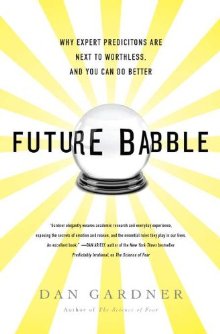
Future Babble: Why Expert Predictions Are Next to Worthless, and You Can Do Better

April 4, 2011
Author:
Dan Gardner
Published:
Dutton Adult, 2011

[+]Future Babble book cover

Amazon | An award-winning journalist uses landmark research to debunk the whole expert prediction industry, and explores the psychology of our obsession with future history.

In 2008, experts predicted gas would hit $20 a gallon; it peaked at $4.10. In 1967, they said the USSR would be the world’s fastest-growing economy by 2000; by 2000, the USSR no longer existed. In 1908, it was pronounced that there would be no more wars in Europe; we all know how that turned out. Face it, experts are about as accurate as dart- throwing monkeys. And yet every day we ask them to predict the future — everything from the weather to the likelihood of a terrorist attack. Future Babble is the first book to examine this phenomenon, showing why our brains yearn for certainty about the future, why we are attracted to those who predict it confidently, and why it’s so easy for us to ignore the trail of outrageously wrong forecasts.

In this fast-paced, example-packed, sometimes darkly hilarious book, journalist Dan Gardner shows how seminal research by UC Berkeley professor Philip Tetlock proved that the more famous a pundit is, the more likely he is to be right about as often as a stopped watch. Gardner also draws on current research in cognitive psychology, political science, and behavioral economics to discover something quite reassuring: The future is always uncertain, but the end is not always near.

The World Wide Web was born just over 22 years ago and now 2 billion people populate it.


Mar 25, 2011

Y RICHARD DOBBS, JAANA REMES, CHARLES ROXBURGH | MARCH 24, 2011

More and more each year, we live in an urban world. Half the global population already lives in cities and generates more than 80 percent of global GDP. And each week, the urban population increases by more than 1 million people, an amount equivalent to adding seven Chicagos to the face of the planet each year.

Futhermore, the center of gravity of the urban landscape is moving south and east, and growth is increasingly coming from second-tier cities. Companies looking for growth and governments engaged in diplomacy, need to build their efforts on an understanding of this urban world at a more granular level. Country-specific thinking may no longer be specific enough.

Mar 8, 2011

Of the European powers, only England and Denmark, in Dr. Fukuyama’s view, developed the three essential institutions of a strong state, the rule of law, and mechanisms to hold the ruler accountable. This successful formula then became adopted by other European states, through a kind of natural selection that favored the most successful variation.

Dr. Fukuyama emphasizes the role of China because it was the first state. The Qin dynasty, founded in 221 B.C., prevailed over tribalism, the default condition of large societies, by developing an official class loyal to the state rather than to family and kin.

Tribalism did not disappear in Europe until a thousand years later. It yielded first to feudalism, an institution in which peasants bound themselves to a lord’s service in return for his protection. So when kings emerged, they seldom acquired absolute power, as did rulers in China, because they had to share power with feudal lords.

Another impediment to absolute rule in Europe, in Dr. Fukuyama’s telling, was that the concept of the rule of law emerged very early, largely because of the church’s development of canon law in the 11th century. So when strong rulers started to build states, they had to take account of the emerging codes of civil law.

Warfare also forced the second major social transition, from tribe to state. States are better organized than tribes and more stable, since tribes tend to dissolve in fighting after the death of a leader. Only because states offered a better chance of survival did people give up the freedom of the tribe for the coercion of the state.

Much of Dr. Fukuyama’s analysis concerns how states develop from tribes. This transition, in his view, is affected by geography, history, and in particular by the order in which the different institutional components of the state are put in place. Depending on the order of events, several very different kinds of state emerged in China, India, the Islamic world and Europe, and even within Europe there have been several major variations on a common theme.


The book traces the development of political order from the earliest human societies, which were small groups of hunter-gatherers. The first major social development, in Dr. Fukuyama’s view, was the transition from hunter-gatherer bands to tribes, made possible by religious ideas that united large numbers of people in worship of a common ancestor. Since a tribe could quickly mobilize many men for warfare, neighboring bands had to tribalize too, or be defeated.


Mar 1, 2011

Almost 30% of the global population now uses the Internet, which grew 14% in 2010, putting it on track to exceed 2 billion users by the end of this year.

The Internet reached 1.97 billion users worldwide in 2010, according to market research by Internet World Stats. Among the chief areas of growth were Twitter and Facebook, which saw 100 million and 250 million new users, respectively.

According to Twitter’s internal data, 25 billion “tweets” were sent in 2010. Asia led the world in Internet users, with some 825 million people online compared with 266 million in North America. However, North America led in percentage of population online, with 77% of Americans, Canadians, and Mexicans having access to the Internet, versus 21% of Asians.